A nomadic Fulani family is watching a robot drawing strange patterns on the ground in the middle of their camp: at first sight this is a peculiar situation, but clearly this Fulani family is at ease. What’s more, these herders have no difficulty whatever in reading the tracks drawn by the robot. A video shows them actually explaining the meaning of the lines to the city dwellers present.
Next scene: the robot again, but in a differed setting: a truck driver is watching his route, he as well explains it and gives an insight in his daily, mobile live. At some point he jokes that he and the Fulani could be considered colleagues, as he is transporting powder milk and they are both working in the mobile dairy busines |
|
 Fieldwork in Cameroon 2008 Fieldwork in Cameroon 2008 |
| |
|
|
locative media art
In her work Esther Polak uses GPS systems. They make it possible to render visible a totally new aspect of the landscape, notably mobility, by means of registered tracks. Two earlier successful projects using this technology were AmsterdanREALTIME and MILKproject.
Esther Polak’s interest thus goes to the mediated imaging of the landscape. But foremost GPS visualization tools are used as communication tool.
|
|
 Milkproject at Making things Public, ZKM 2004 Milkproject at Making things Public, ZKM 2004 |
| |
|
|
Mobile live style
The NomadicMILK project is meant to reflect the itineraries of people with a primarily mobile way of life. To this end Esther Polak will work in Nigeria, where the dairy economy relies on mobility. On the one hand we have the Fulani nomads, shepherds who move with their herds from one good pasture to the next, and on the other the distribution of regular dairy products, which is seen to by truckers, traders in the markets, harbor tycoons and distribution agencies. In both these economic environments Polak will invite people to register their routes; subsequently their routes will be visualized in the field and discussed with the participants, thus making also the personal story behind the routes visible.
|
|
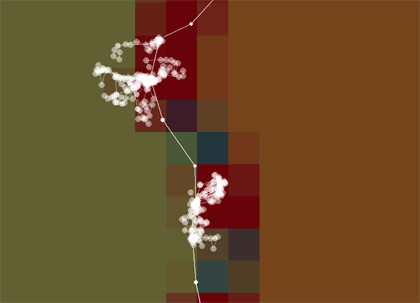
Zebu-cow transhumance and grazing route:
from one camp to the other and daily grazing routes (North Cameroon) |
| |
|
|
The robot
For the purpose of this particular project Esther Polak will develop a new tool: a small robot, which can store the GPS routes and subsequently lay them out on the ground, in sand. The robot is actually a very simple sandglass on wheels. It converts data on a time scale as well as on a space scale. If a track slows down, or even stops for a short time, the robot too will slow down and leave a thicker track, or even just a tiny heap of sand.
|
|
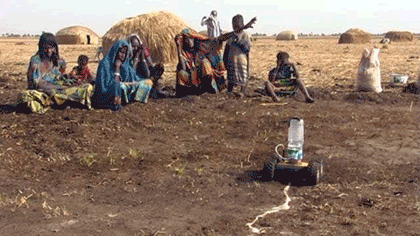
Robot Workshop North Cameroon 2008 |
| |
|
|
Project results
The project will result in an installation and a website. The installation will consist of the sand tracks drawn by the robot combined with audio – visual registration of the robot interaction with the participants and footage of their daily live.
The website will be designed primary for mobile devices/phones, as we expect African audiences to adapt to this technology rapidly.
To execute the project Esther Polak will work with a small team. Primary artistic fieldwork has been executed in Nigeria and Cameroon, the team is now ready to execute the project in it final stage.
|
|
 Installation try-out based on field work in Nigeria Installation try-out based on field work in Nigeria
Co-ops programme, Leiden, NL 2007 |
| |
|
|
